
At home, she put the groceries away, made tea, and opened her notebook.
She wasn’t sure what she was looking for, only that the last few weeks had started to feel slightly off.
She began with the old couple.
Two weeks ago: lovers.
A few days ago: angry neighbors.
Then the hospital.
Few weeks ago: dumpsters, delivery truck, men unloading boxes.
Today: benches, trees, patients, chess.
She thought about some of the other cases.
The school corridor. She remembered boxes stacked against the wall before she called it MULTIPURPOSE ACCESS AREA. Or were they carts? And how about the GREEN BUFFER. Had it already had a fence along the side? She added them to the page with question marks.
She stared at the list and wondered if the “off” feeling is something else and she is just trying to invent reasons. And then she opened the Department system with the history of her cases, and she began adding dates to her notebook notes.
March 18: BENCH case. That was the day she had closed the file.
She tries to remember when she saw first the TV story. It was a Friday, not long after she closed the case. A quick search on the TV stations’ web page confirmed it.
April 2: Lovers’ Bench story
And then April 10: Oak Street Wall at Center of Neighborhood Dispute.
Before moving to the hospital case, she notices the mark on her calendar April 3: Coffee with Claire. She remembered that afternoon easily, the pleasure of speaking French, Claire stirring her second coffee while she tried to describe the long stone structure. She ponders for a second, then adds it to the notebook. Nothing else of importance seems to have happened in those days.
She continues to document the other cases, adding notes from her personal calendar (not very busy) and everything else she could remember that had any connection at all with her cases in the last several weeks.
Then she started crossing things out.
The dentist obviously had nothing to do with anything. The electricity bill and laundry could safely go too. She hesitated over lunch with Maria and the call with the landlord, but couldn’t remember discussing work at all, so crossed those out as well.
She left the haircut, where her stylist talked constantly, and she usually talked back. She could not remember now whether any of the cases had come up, so she left a small question mark beside it.
When she was done, the page looked like this:
March 18: BENCH
April 2: SERVICE COURTYARD
April 2: Saw the hospital courtyard on the way home. Dumpsters, delivery truck, men unloading boxes.
April 2: Lovers’ Bench.
April 3: Coffee with Claire. French. Parlé du vieux couple et du muret.
April 4: Haircut, 11:30.?
April 6: GREEN BUFFER
April 7: Dentist.
April 8: BOARDING PLATFORM
April 9: Call landlord.
April 9: SHIFT TRANSITION
April 9: STUDY COLLECTION
April 9: Oak Street Wall at Center of Neighborhood Dispute.
April 12: Lunch with Maria.
April 15: Pay electricity.
April 17: Claire called.
April 18: Laundry.
April 22: MULTIPURPOSE ACCESS AREA
April 23: Hospital complaint.
April 26: Call Ana. Hometown news. Romanian. Părculețul de la biblioteca.
April 26: Hospital. Benches, trees, patients, chess.
She read through the list twice.
The obvious place to start, she decided, was with the question marks. The grass strip, the museum study collection, the school corridor. She drew a small circle around the three cases.
Over the next few days, she checked the places she had circled in her notebook, but nothing seemed particularly strange. Nevertheless, she wrote the findings down.
She even stopped by the hair salon one afternoon and asked for a quick trim she didn’t really need. Her stylist was telling her about a neighbor who had put up a fence between two houses and started an argument that had apparently involved three families, a dog and, somehow, the police.
“A fence,” she said. “I’ve been seeing fences everywhere lately.”
Her stylist laughed.
“You and those strange cases from work.”
She looked at her in the mirror.
“Did we talk about the fence?”
Her stylist thought for a moment.
“Maybe. Or maybe it was something about a school that was bothering you last time.”
Then she went back to the dog. That was as far as they got before she remembered another story about the new bakery and moved on.
She wrote haircut: school? fence? in the notebook when she got home.
After a week she realized she was getting nowhere with the old cases, so she decided to be more intentional about the new ones. She no longer named them immediately and, whenever the place was close enough, she went to see it first, taking notes in the notebook.
One of the first cases she documented was a covered area behind a community center. She took pictures of it and back at the Department, she looked at the photographs carefully, before entering WAITING AREA in the classification field. Two days later she passed by again. The chairs she saw few days ago were no longer stacked but arranged along the wall and three people were sitting there waiting for an evening class to begin. There was nothing particularly strange about any of it, but she added the date to her notebook anyway.
Another case involved a wide concrete ledge outside an apartment building. Before naming it, she found flowerpots at one end, two packages in the middle, and a little boy walking along the top while his mother talked on the phone nearby. Back at work, she called it DELIVERY SHELF. When she returned a few days later, five packages were lined up neatly along it. She stood across the street for a while, looking at them and trying to decide what exactly she had expected to find.
By the end of the week, several pages of the notebook were filled with dates, classifications, and descriptions of what she had seen before and after each case passed through her desk. They proved absolutely nothing, which was beginning to annoy her more than she wanted to admit.
On Monday morning, a new case arrived involving a rectangular concrete structure in the courtyard of a public housing building. In the photographs, children were sitting on it, someone had left groceries there, and an elderly man appeared to be using one end to repair a bicycle. She put on her coat and went to see it for herself. The place was exactly like she would have expected it from the photographs, but she stayed long enough to be sure there was nothing else to notice.
Back at the office she considered the usual sort of names.
PLAY PLATFORM would not have been wrong. Neither would REPAIR BENCH.
For several minutes she moved between the two, dissatisfied with both, and then, almost out of irritation, deliberately chose the least obvious possibility she could still defend.
PICNIC TABLE
It was too low, too wide and had no seats, but people had certainly eaten lunch on less suitable things.
She saved the file.
That evening, on her way home, she walked through the housing complex again.
A family had spread a checked cloth over one end of the concrete structure. There were paper plates, a bottle of juice, a bowl of strawberries and several containers with their lids stacked beside them. Two adults sat on folding chairs they had brought from somewhere, while three children moved between the food and the grass, eating with their hands. Someone had placed a small portable speaker on the concrete, and music played softly into the warm evening.
Nobody seemed to find any of this remarkable.
At home, she opened the notebook and added the date beneath PICNIC TABLE.
For a while she simply looked at what she had written over the past few weeks: the bench and the wall, the hospital courtyard and the little park, Claire speaking French, Ana speaking about their hometown, the waiting area, the delivery shelf, the names from work and the things she had seen before and after them.
She turned back several pages, then forward again. She drew a circle around one date, then another. Underlined a word. Crossed something out, changed her mind and wrote it back in the margin.
After a while she stopped writing altogether.
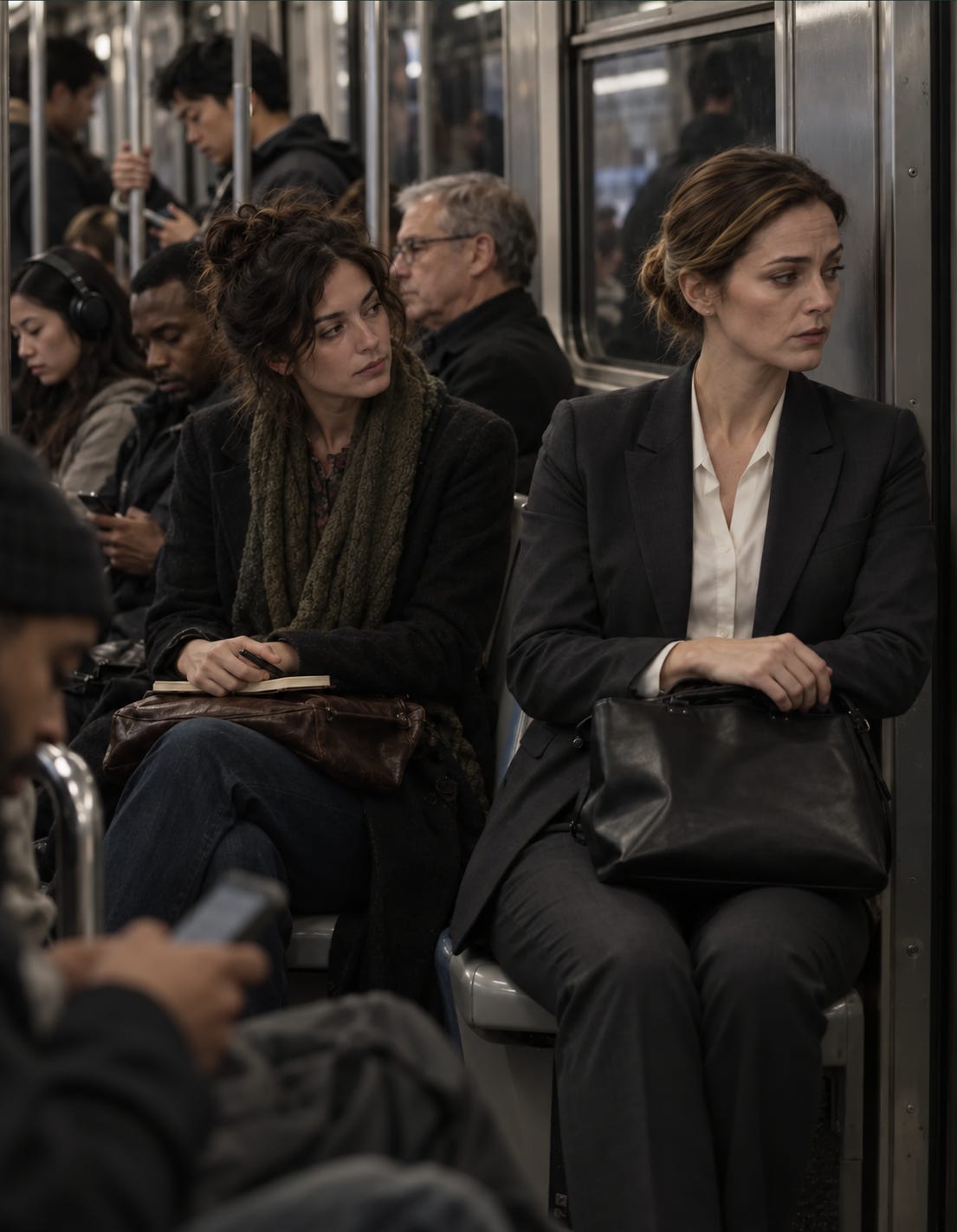
The next morning, the subway was crowded as usual. She stood near the door, watching people without quite meaning to, when she saw the woman in the business suit again. Another job interview, she thought automatically, when she caught herself. She remembered the story she had made up the first time she saw the woman: the ice-cream truck waiting outside the next station, the woman driving through the neighborhood and knowing all the children by name.
She looked at her for a long while.
Then, very carefully, she chose a word.
Happy.
At the next station, the woman got off.
She watched her disappear into the crowd and did not replace the word with another one.