
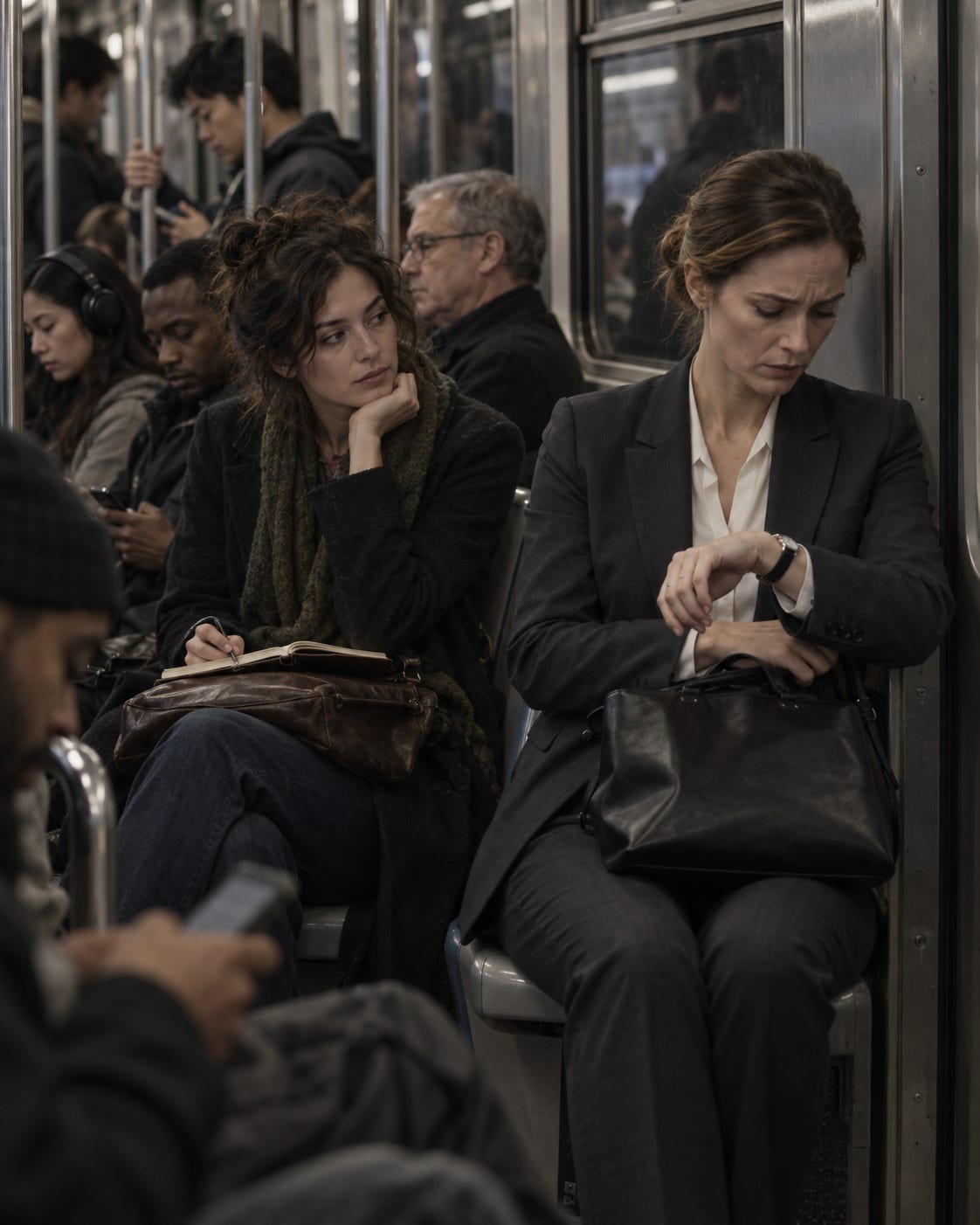
The subway was more crowded than usual, but she still managed to find a seat next to the door.
She liked to sit and watch people. Most of them were looking at their phones. Some had headphones on and stared into the void. A few stared into the void without any phone or headphones visible. Even fewer were having a conversation.
She would choose a few and give them names. Then she would imagine where they were going, and why.
She didn’t like to imagine the obvious.
The woman in the business suit, for example, looked anxious and kept checking the time. She was probably going to a job interview, for a job she might or might not be qualified for. She named her Anna. Anna was very rich and loved ice cream. An ice-cream truck was waiting for her outside the next station. Anna would climb into it and drive slowly through a neighborhood where she knew the names of all the children living in all the apartments along the block.
Sometimes, in the evening, she wrote down the stories she liked best. The evening part was also when she chose the language. She knew several and rarely had a chance to use most of them, so she alternated. Some evenings she wrote in in French, others in Italian, and at least once every week she wrote in Romanian.
The stories changed slightly depending on the language. Some gave her more words to work with than others.
By nine every morning, she was at her desk at the Department of Unnamed Things.
The name was more interesting than the work. Most days she answered emails and corrected forms. But last week was better. She had two new cases: a space between two buildings that was too narrow to be called an alley and a staircase that ended above the pavement. Her job was to find a name for them. Once named, they could be entered into the system. That was considered a successful resolution.
Today they received a complaint about the patch of ground behind the General Hospital. It appears on every city map but has no official designation. People sit there, wait, smoke, cry. Too many of them cry, apparently.
She entered in the form: SERVICE COURTYARD
On her way back from work, she passed by the General Hospital Tucked behind the main building, the dumpsters stood in a row. A truck was parked next to a delivery door, and two men in blue overalls were unloading boxes.
After a simple dinner she turned on the TV, in time for the local news. An older couple is telling the story of their lives. “Right here, on this bench, we meet for the first time” the woman says. It looked somehow familiar. Or maybe it was the alley. A solitary bench on an alley with oak trees, somehow odd to find it there. You would expect benches in a park. Then she remembered. It was case she had few weeks ago, at the beginning of spring. A long stone structure in a narrow pedestrian lane. She named it BENCH.
She smiled as the report ended with the old couple standing beside it, looking at each other more than at the camera. Someone in the neighborhood had hung a small sign on the tree beside them: LOVERS’ BENCH.
The next day she met Claire for coffee.
They had known each other for years and had somehow kept speaking French together, even though Claire spoke perfectly good English. It had started as practice and then simply became the language in which they knew each other.
She told Claire about the news story.
« Il y avait ce couple, très vieux maintenant. Ils se sont rencontrés au même endroit il y a… je ne sais pas, quarante ans peut-être. »
« C’est mignon. »
« Oui. Et je connaissais l’endroit. J’avais eu le dossier au bureau. »
She tried to describe it.
« C’est dans une petite rue piétonne, avec des chênes. Et au milieu il y a une longue… »
She stopped.
She searched for the word and couldn’t find it. The word bench came in English, but she wasn’t speaking English.
She moved her hand horizontally over the table.
« Une sorte de muret en pierre. Assez bas. Les gens peuvent s’asseoir dessus, mais les enfants montent aussi dessus, les vélos sont souvent appuyés contre… »
Claire stirred her coffee.
« Un muret, alors. »
« Oui. Un muret. »
They ordered another coffee and started talking about something else.
The next few days brought easier cases, like the narrow strip of grass between a parking lot and a row of garages that she called GREEN BUFFER, or the wooden platform beside a bus stop. She named it BOARDING PLATFORM.
On Friday, the first case was about eleven minutes. Every afternoon, a factory stopped one production line while the morning crew left, and the evening crew arrived. The eleven minutes appeared on payroll reports, safety records, and production schedules, but each department called them something different. She named them: SHIFT TRANSITION.
The second one was from the History Museum. They sent photographs of a glass case containing objects that had been donated but didn’t fit in any collection. A brass key, a child’s shoe, three postcards and a broken compass. She thought about that one longer. STUDY COLLECTION, she finally typed.
For reasons she had never been able to explain, the Friday cases were usually the best ones.
That evening she turned on the TV while washing the dishes. The local news was already on. She was not really listening until she heard the name of the street. The one with the oaks and the lover’s bench. “They really like that romantic story, playing it twice in couple of weeks” she thought as she turned toward the TV.
The woman was speaking. “The little wall should be left alone” she said, “it doesn’t harm anyone and I’ve used it many times to rest”. The man beside her disagreed. The stones were cracked, skateboarders had chipped the edges, and the city should either repair it properly or remove it. They interrupted each other more than once. The reporter called it a neighborhood dispute that had been going on for years.
She dried her hands and came closer to the television. She knew those faces, the old woman and the old man. Only, she knew them as a couple, a loving couple - not as angry neighbors.
She stayed in front of the TV until the story ended.
… to be continued