
Read part 1 here: The Department of Unnamed Things - part 1
***
After that, she went online to look for the news story a couple of weeks earlier. Maybe they just looked very similar, she thought, though she could swear they were the same people. She searched for lovers’ bench, then for the name of the street, then for the old couple. Nothing came up, there was no lovers’ bench story in the online archive. She gave up after a while, after all local news websites were not exactly known for their search functions.
The next morning, she found the case file at work.
A long stone structure along a pedestrian route...
She scrolled down.
There it was, in the form: BENCH
After the coffee break, she decided to look at the news station archive again. Maybe she had been too tired the night before.
And there it was, aired exactly two weeks earlier.
LOVERS’ BENCH: COUPLE RETURNS TO THE PLACE WHERE THEY FIRST MET
She watched it again. She had remembered correctly. The same woman and the same man, staying close to each other, smiling, telling the reporter that this was where they had first met.
She thought about the report from the night before. Hiring actors for local news now? That was pretty sad. Couldn’t they find real people anymore? And airing the two stories only two weeks apart? Surely, she couldn’t be the only person who had recognized them.
In any case, she was relieved that at least her memory was not playing tricks on her and went back to work.
Claire called a few days later. They talked about Claire’s volunteering and the trip she was planning for the end of the year, a long-awaited trip to Africa. Just before saying goodbye, Claire remembered something.
« Ah, le petit muret… tu te rappelles ? »
She had passed by it the day before and recognized the street from her story.
« La rue est magnifique, mais le muret n’a rien de très romantique. Il y avait plein d’enfants dessus. »
She laughed.
« Peut-être que ton histoire était meilleure. »
They said goodbye, but for the rest of the afternoon she kept thinking at what Claire said: “le muret n’a rien de très romantique”
After a salad dinner and a glass of white wine, she opened the computer again.
How could she find out whether the man and the woman had appeared in other news stories? And who were they, anyway? She couldn’t quite say why she was so interested.
Maybe I’m just bored, she thought.
Still, it was as good a way to spend an evening as any.
She started with the woman. It took less than twenty minutes to find her in another report from the previous year. She was standing outside a pharmacy, complaining about the new parking restrictions on the street. Same short gray hair, same glasses, same voice.
There you go.
At the bottom of the screen, a thin band appeared for a few seconds:
ELISE MARTIN - LOCAL RESIDENT
She searched for the man next. He was harder to find, but eventually she spotted him in a story about a neighborhood petition against cutting down several old trees. Same cap, same impatient way of speaking.
PAUL RENAUD - LOCAL RESIDENT
She leaned back in her chair. So, they were real people. Probably the kind of people who knew the local reporters and loved being on TV.
That explained quite a lot. Or at least enough for one evening.
For the next two weeks, she had no reason to think about Elise Martin or Paul Renaud. There was plenty of work at the Department, including a complicated case involving a school corridor that was used for storage during the holidays and as an emergency exit during the rest of the year. She eventually called it MULTIPURPOSE ACCESS AREA, although she was not particularly happy with the name.
On Thursday, an email arrived from the General Hospital. She recognized the case, it was the patch of ground behind the building. SERVICE COURTYARD.
The email was from a woman who worked with the hospital volunteers. Apparently, following the Department’s classification, Facilities had taken responsibility for the area and the dumpsters had been moved closer to the wall, parking spaces had been marked for delivery trucks, and a sign had been installed to prevent unauthorized access.
The woman asked whether the classification could be reconsidered. For years, patients and their families had used the space to get some fresh air and a place to be alone for a while. The hospital had very few places where people could sit outside, and now they were being told that the courtyard was reserved for service vehicles.
She opened the original complaint. “People sit there, wait, smoke, cry.”
Too many of them cry, apparently.
She remembered passing the place on her way home and seeing the dumpsters and the delivery truck and no patients. Actually, no chairs or benches or nothing where they would even sit to rest.
She read the email again. Perhaps SERVICE COURTYARD had not been the best choice after all. She could change it to PATIENT REST AREA, although that didn’t seem entirely right either.
She asked her supervisor.
He looked at the original complaint, then at the photographs.
“The classification is correct. If the hospital wants to change how the space is used, they can submit a request. That’s not our responsibility.”
She supposed he was right. Her job was to name things, and she had named it.
She sent the response to the volunteer. Another successful resolution. Maybe.
A few days later, she called a Romanian friend from high school. They hadn’t spoken in months, and there was plenty to catch up on. Her friend had recently visited their hometown. The old cinema had been demolished, a supermarket had opened where the bus station used to be, and the little park behind the library was going to become a parking lot.
„Mai ții minte părculețul ăla? Unde stăteam după ore?”
Of course she remembered. They had spent entire afternoons there, talking about things that seemed terribly important at the time.
„Acum vor să facă parcare acolo. Cică nu-i folosit.”
„Ce prostie! Și eu am avut un caz asemănător la serviciu. Un părculeț în spatele unui spital, unde ieșeau pacienții și familiile lor. Stăteau acolo, mai fumau, mai plângeau… Acum nu mai au voie să intre.”
„De ce?”
„O încurcătură administrativă.”
„Măcar copacii i-au lăsat?”
„Nu știu. Sper că da.”
They spent another twenty minutes remembering people from high school, trying to work out who was still living in town and who had moved away.
That evening she had a few things to buy and the supermarket
near the hospital was usually less crowded. She passed the courtyard almost
without thinking.
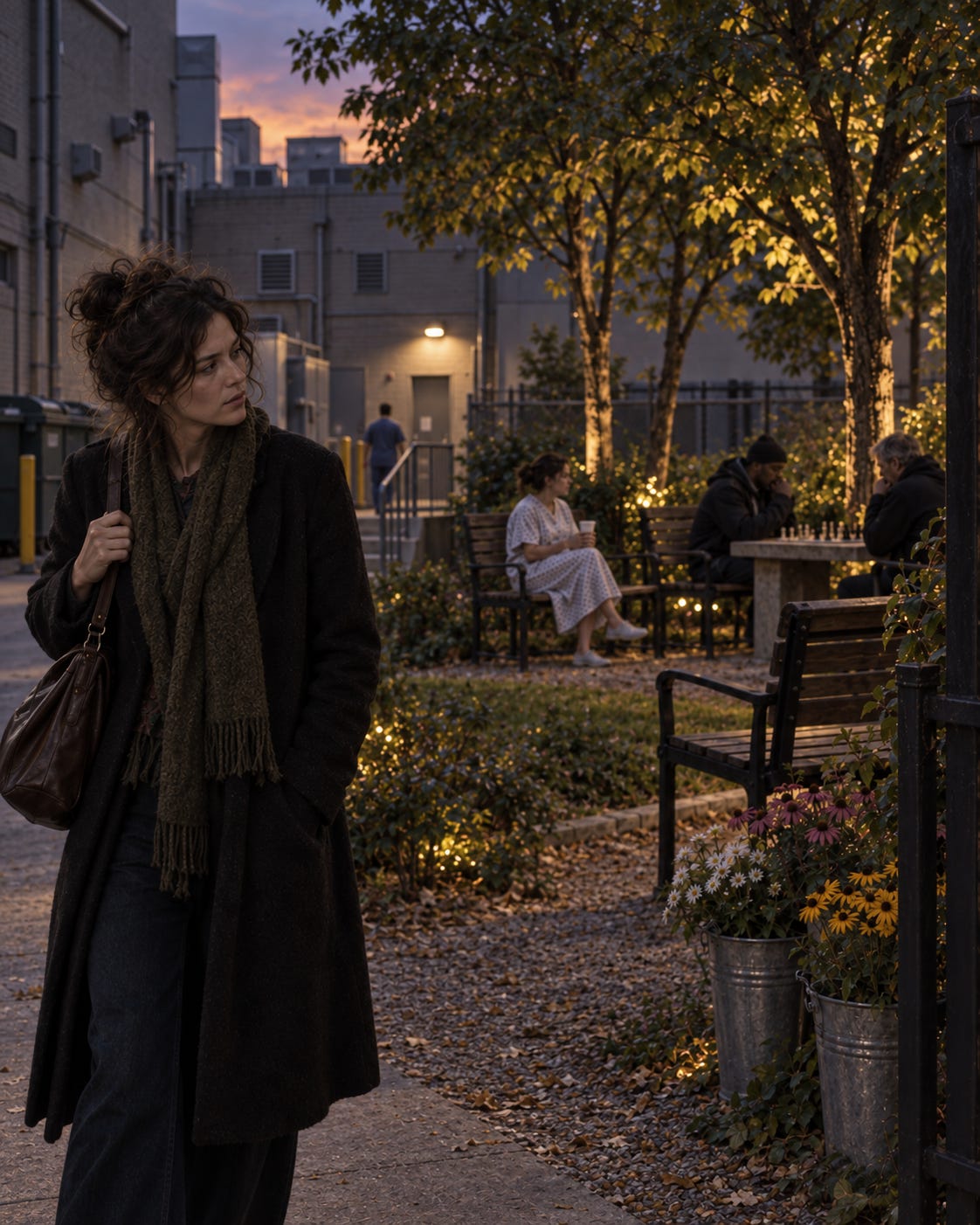
There were three benches under a row of trees, and a narrow path led from the hospital’s back entrance to a small patch of grass. A woman in a hospital gown was sitting on one of the benches, holding a paper cup. Two men were playing chess at a little concrete table. Someone had planted flowers in three old metal buckets along the fence.
She stopped.
How on earth had they managed to change it so quickly? It had only been a few days since the email from the volunteers.
She looked around. Benches, a path, trees, even a little table for playing chess.
Impossible to have done all that in the last few days, even if they managed to get it suddenly approved, she thought.
She tried to remember exactly what she’d seen last time she passed by few weeks ago. There were the dumpsters by the wall, the truck, the two men unloading boxes. She was quite sure about those. But has she seen the trees? She doesn’t remember the tress. “They could have been there, still, I suppose …”
She stood there for another minute, rather annoyed that she couldn’t make sense of it, then continued toward the supermarket.
— to be continued
Note: images are AI generated.