
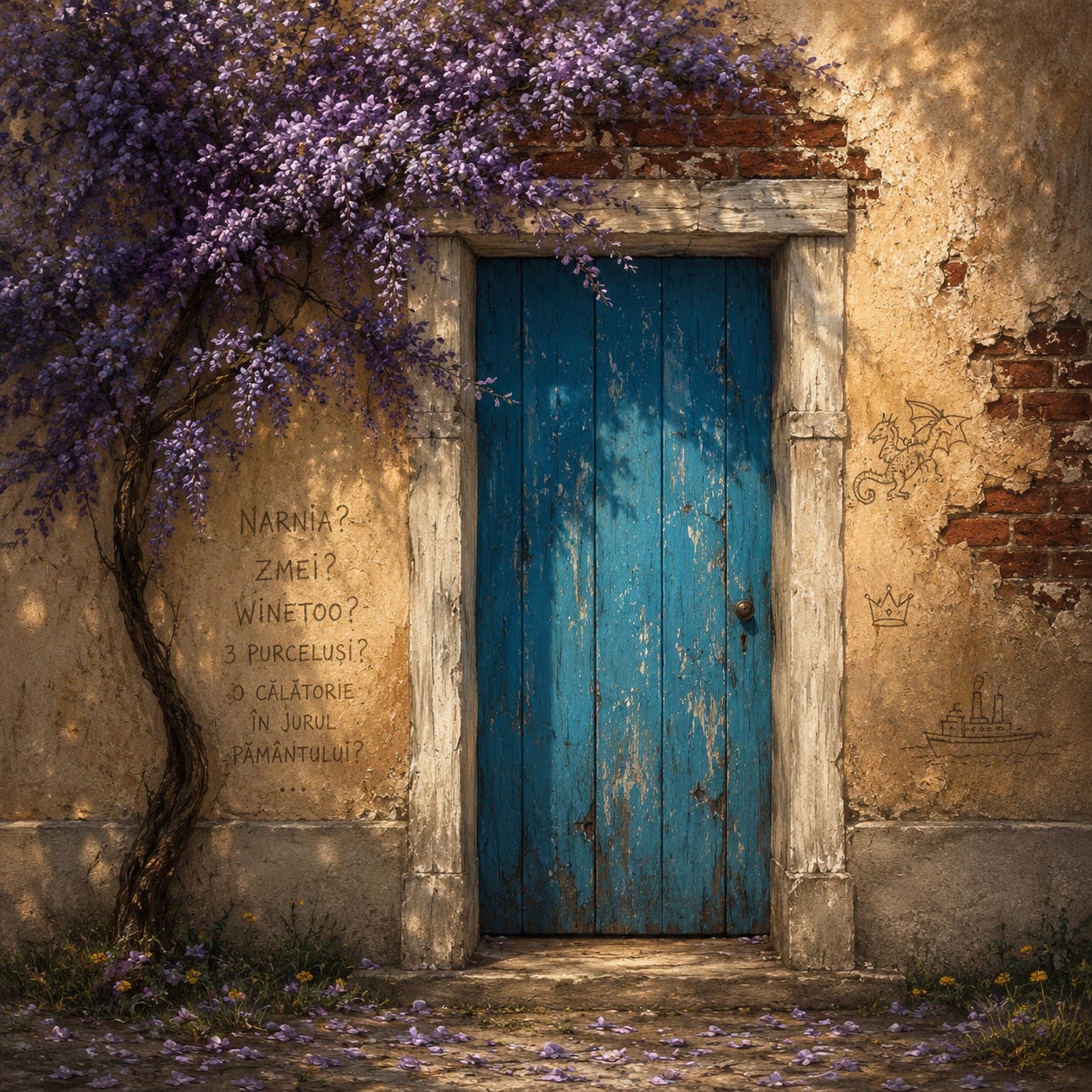
This story is another possible interpretation of the door in Ada’s grandparent’s village (see The Door in the Wall - by Notes from Elsewhere)
The story starts the same:
There was a door in Ada’s grandparents’ village that no longer belonged to any house.
The house had disappeared long before Ada was born. First the roof collapsed, then one wall, then the other, and after a few years nobody was entirely sure where the yard had ended and the road had begun.
Only the door remained.
Every spring it disappeared beneath purple blossoms.
The tree was one of those trees that seem to take flowering personally, covering itself with so many blooms that within a few days you could no longer see the trunk or the branches, only a violet explosion that appeared to have landed accidentally in the middle of the world.
But … this time Ada doesnt go asking around the village
The door was always closed and that, more than anything else, bothered Ada.
Not because there was anything remarkable on the other side. If she stood a few steps to the left, she could see perfectly well what was behind it: a field, some grass, a path leading toward the creek and, farther away, the first houses at the edge of the village.
And yet the door remained closed.
Every day during the summer she passed it several times. On the way to the well. On the way back from the store when her grandmother sent her to buy bread, yeast, or the small sour candies she pretended not to like. On the way to Tanti Tanta’s house carrying apples, eggs, jars, messages, and occasionally information that seemed far too complicated to trust to a child but was entrusted to her anyway.
Every time she passed the door she wondered what would happen if she opened it.
Not what was behind it, that was clear and visible, but what would happen. These seemed to Ada like two entirely different questions.
That summer she was reading Narnia, and the situation became considerably more complicated.
The fact that she could see a field behind the door no longer proved anything. Books had already established that wardrobes were unreliable, mirrors were suspicious, and ordinary-looking objects frequently concealed entire worlds. There was no reason a blue door in a village in Muntenia should behave more honestly than a wardrobe in England.
For several weeks she became convinced that the field was merely a disguise and the real world would reveal itself only after the door opened.
The difficulty was deciding which world she wanted to uncover.
She considered Narnia itself, it seemed like a promising outcome.
On the other hand, if she opened the door and found herself in the story of the Three Little Pigs, she would be deeply disappointed. The entire story irritated her. Everyone made poor decisions and the ending felt undeserved.
Some fairy tales suffered from similar problems. The handsome prince was rarely the most interesting person in the story and even Ileana Cosânzeana, despite possessing exceptionally beautiful hair, appeared to spend too much time waiting for other people to solve her problems.
Winnetou was more attractive. A Journey Around the World in Eighty Days also had potential. Narnia remained a strong candidate.
The summer passed. Then another one. Then another one. The door remained closed.
Ada continued thinking. She got more and more convinced that choosing the wrong story could have serious consequences. If the door opened into a world she did not like, she might be forced to stay there. Books were strangely vague on this subject.
She decided to wait until she was sure.
Years later she realized that she had never opened the door.
The door, meanwhile, appeared perfectly willing to wait.
Later she wrote down the explanation.
EVERY DOOR LEADS SOMEWHERE.
TECHNICALLY CORRECT.
THE DIFFICULT PART IS DECIDING WHICH STORY YOU ARE ENTERING.
Wonderful story! Excellent ending!