
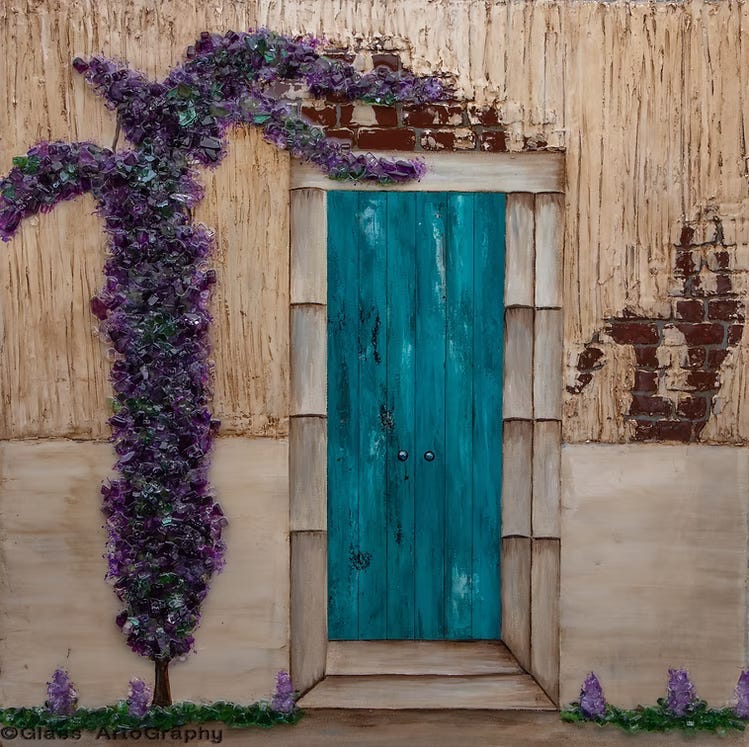
There was a door in her grandparents’ village that no longer belonged to any house.
The house had disappeared long before Ada was born. First the roof collapsed, then one wall, then the other, and after a few years nobody was entirely sure where the yard had ended and the road had begun.
Only the door remained.
It was painted a vivid blue, though nobody remembered who had painted it or why they had chosen that particular shade, which seemed more appropriate for a place by the sea than for a village hundreds of miles from any real body of water.
Every spring it disappeared beneath purple blossoms. The tree was one of those trees that seem to take flowering personally, covering itself with so many blooms that within a few days you can no longer see the trunk or the branches, only a violet explosion that appears to have landed accidentally in the middle of the world.
The tree seemed to have grown out of the wall, while the wall seemed to have grown around the tree. If you stared at them long enough, you began to suspect that neither had come first.
“Who planted it?” Ada asked.
Her grandmother shrugged.
“It’s always been there.”
By then Ada already knew that this was never the real answer. Adults said it’s always been there when they didn’t know the answer, or when they had forgotten it.
So she began asking around the village.
Aunt Victoria was convinced the tree had been planted by a woman waiting for her husband to return from the war.
Mr. Pandele insisted there had been no woman and no war. According to him, the tree had been planted by a retired schoolteacher who wanted to prove that flowers grew better beside doors than beside windows.
The pharmacist claimed it was a rare variety brought from Bulgaria.
The priest believed that some things did not need to be explained.
This was also his explanation for a great many other things.
Ada kept asking questions all summer, and by the end of August she had collected seven different explanations for the tree, two serious disagreements about its blossoms, and a nearly twenty-minute argument between Mr. Pandele and the pharmacist over whether Bulgaria produced lilac varieties hardy enough to survive winters in Muntenia.
She had learned nothing about the door.
Only then did it begin to seem strange.
Everyone talked about the blossoms. Their color. Their fragrance. The woman waiting for her husband to return from the war. The retired schoolteacher conducting botanical experiments.
Nobody seemed interested in the door.
One hot afternoon Ada sat in the grass and studied it for a long time.
That was when she noticed something.
Nobody was entirely sure on which side of the door the house had once stood.
Her grandmother was convinced it had been on one side. Mr. Pandele was equally convinced it had been on the other. The pharmacist agreed with her grandmother. The postman agreed with Mr. Pandele.
The more people Ada asked, the harder the house became to find.
Eventually she realized that the door had survived the house for so long that people had forgotten what it had once separated.
Later she wrote down the explanation.
EVERY DOOR LEADS SOMEWHERE.
TECHNICALLY CORRECT.
The problem is that, given enough time, nobody remembers which direction.
The piece is currently on display at Macrina Bakery in Belltown, Seattle through the end of July. See Lilian’s body of work at Gallery | Glass ArtoGraphy