
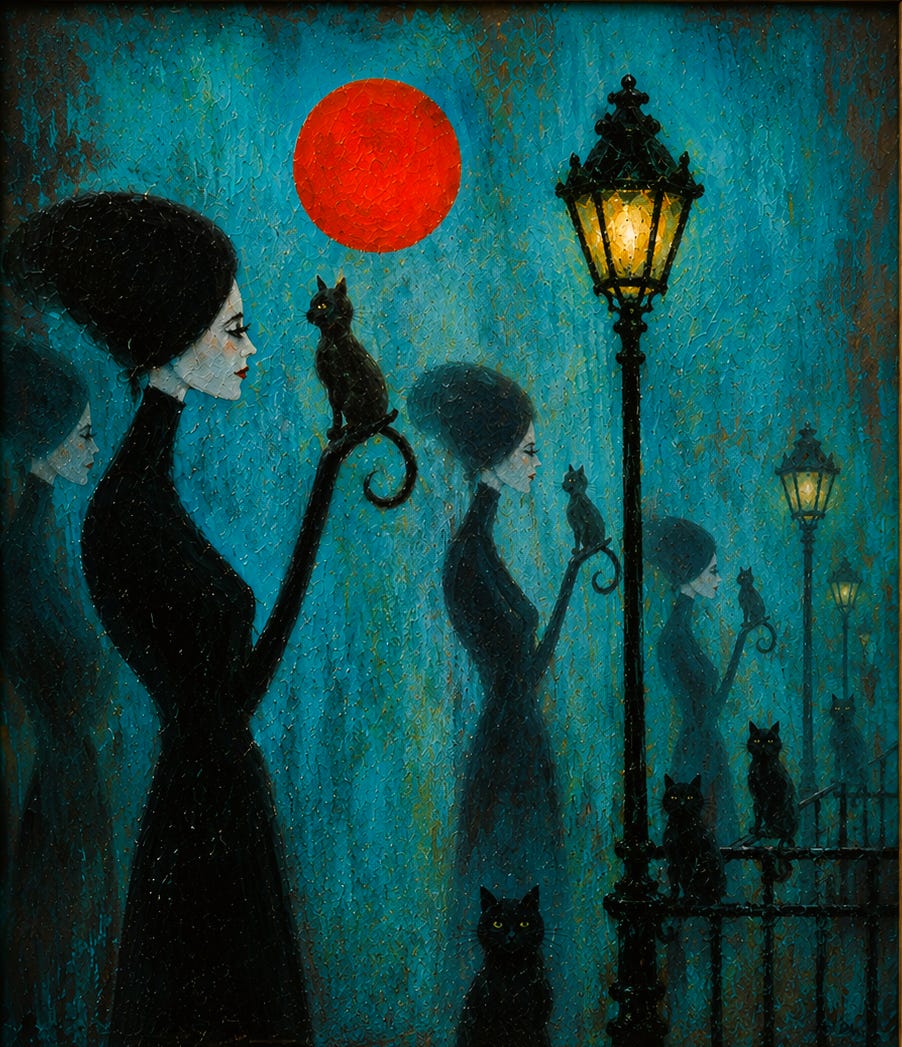
The lamp had been standing there longer than the town remembered.
Long enough to observe the bridge through storms, through wars, through winters so heavy the river disappeared beneath ice, and summers filled with music drifting from open windows. Long enough to witness the slow replacement of nearly every human face that crossed beneath it.
The moon remembered even more.
But unlike human beings, neither the lamp nor the moon insisted on remembering things the same way twice.
She was five years old and at the market with her mother. Across from their own cart, where they were selling ceramic pots and cups carefully painted by her mother, there was an old woman who sold animals crocheted from wool. They looked alive, as though at any moment they might jump down from the cart and begin running through the market between people’s legs and wooden tables. Rabbits with folded ears. Foxes with narrow faces. A small owl whose glass eyes reflected the morning light too sharply.
And the cat.
The cat had black wool fur and thin whiskers stitched carefully into its face. Its button eyes were darker than the others somehow, glossy, and from certain angles, they seemed to contain reflections.
Every market day that spring, the little girl had stopped in front of that cart to look at it.
And every week her mother said:
“When we sell the pottery, I will buy it for you.”
The market was nearly over now. Vendors were packing away crates and folding canvas covers over the remaining goods. The evening light had turned blue around the edges, and above the square the moon had already appeared. Near the center of the market, the old iron lamp had begun to glow.
Just as they were starting to pack, a customer came by. They sold the last two sets. The girl did not even wait for the customer to leave properly before running toward the old woman’s cart.
But behind her, her mother stopped her. “No. We need the money for shoes for your sister. Her old pair has a hole in the sole.”
The girl stopped halfway. For a second, she genuinely did not understand the words. She looked back at her mom, and then again at the old woman and the cat. The old woman behind the cart said nothing.
The girl walked the remaining distance slowly now until she stood beside the cat. Up close, its eyes looked even stranger. Not made of buttons after all, but something darker and reflective, like wet seeds.
She reached out and placed her hand on its head.
“No,” her mother said again. “Leave it there.”
And then something happened. Her heart began beating so fast it hurt. Something hot and heavy moving upward through her body.
The market sounds changed first. Voices became distant. Metal clinking somewhere slowed strangely. A pigeon crossing the square stopped midway.
The old woman looked at her carefully and the little girl understood suddenly that the universe was waiting to see whether she would accept this world or refuse it.
Behind her, her mother took one step forward, her voice growing louder.
Her fingers tightened around the wool cat.
And in that split second the world separated.
In the old one, the child removed her hand obediently and walked back toward the pottery cart carrying nothing.
But there was another one too.
And there, she took the cat.
From that moment on, things no longer remained entirely the same.
The lamp remembered that worlds rarely separated through grand events.
Usually it happened through smaller things.
A hand closing instead of opening.
Someone refusing to let go.
Someone continuing to call into the dark after everyone else had already accepted silence.
Sometimes the moon illuminated streets that did not entirely exist.
And now and then, beneath the lamp, those who refused loss too fiercely seemed able to cross between them.
A boy once lost his dog beside the river and searched for three days without finding it. By the fourth evening, everyone else had already accepted the loss. But beneath the bridge, under the lamp, the boy kept calling the dog’s name into the fog long after the town had gone to sleep. The lamp flickered once. The black cat looked at the woman. Somewhere in the darkness, paws struck wet stone, running fast toward him.
There was a young man who crossed the bridge every evening with the woman he loved until one autumn night she stopped beneath the lamp and told him she would not be leaving the town with him after all. The river moved black beneath them. Somewhere far away, a church bell rang once. The woman turned and began walking back toward the town. “No,” the young man said, with the desperate certainty of someone refusing to allow the world to become that version of itself. The lamp flickered once above them. Beside the lamp, the cat opened its eyes. Years later, watching his wife asleep beside him, the man would still sometimes remember that night and feel strangely certain it was not the tears in his eyes that made him glimpse, for a moment, another version of the bridge where the woman never turned back at all, but continued walking alone into the fog while his own world remained standing beneath the lamp, waiting for him.
Sometimes, very late at night, the lamp flickered long enough for the shadows beneath it to separate incorrectly again, as though a nearby universe had drifted too close.
The moon sees all versions of the woman at once.
The woman carrying the cat in her arms.
The cat alone beneath the bridge, staring upward with unblinking eyes.
The hat moving across the street without wind.
The lonely woman leaning over the dark water.
There is no cat.
No.
At the far end of the street now. Smaller somehow. Thinner.
The lamp flickers.
For a moment the shadows beneath it separate incorrectly.
Then settle again.
From the series Not Everyone Sees the Same Cat, based on Dave’s interpretation