
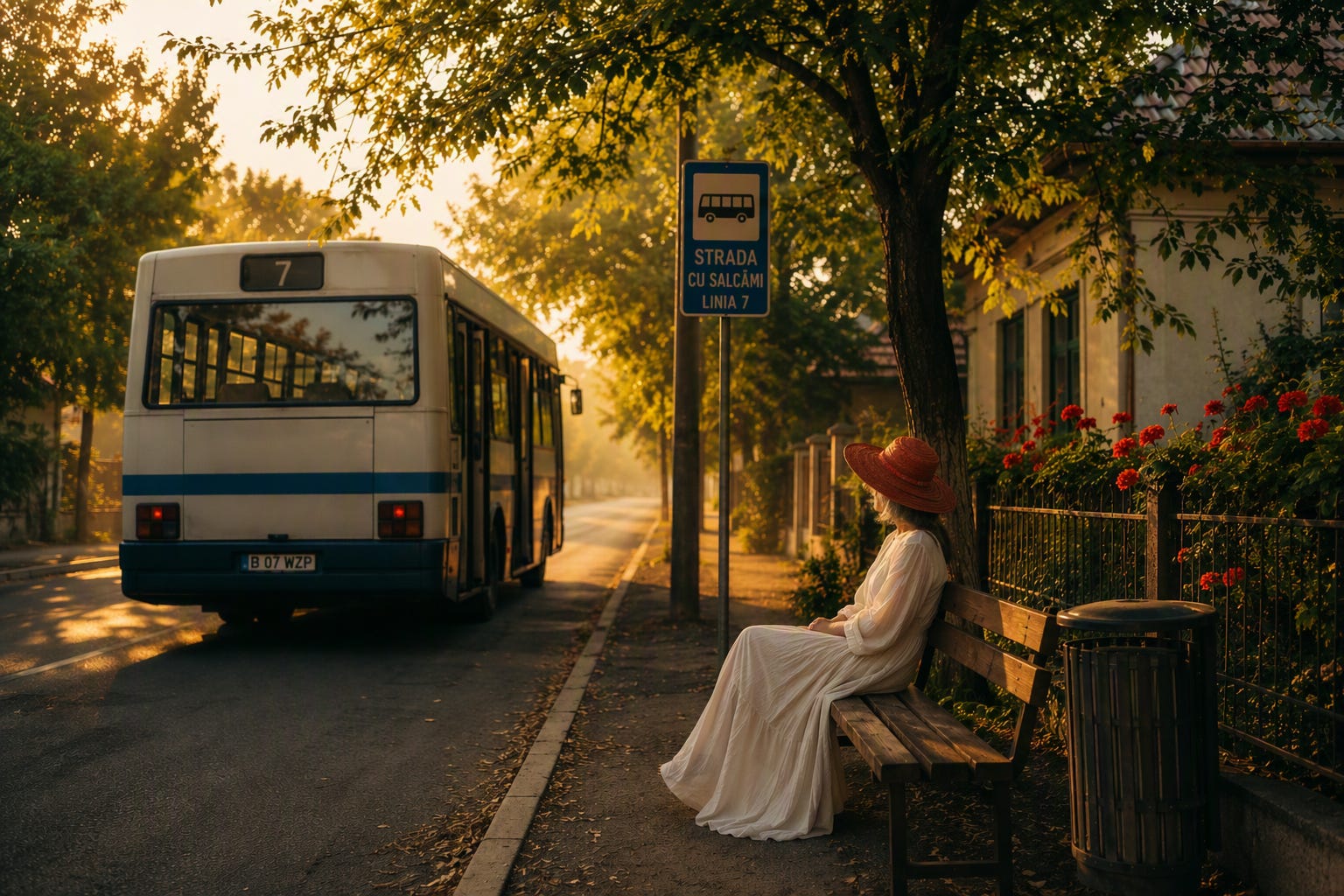
The dream began on a Tuesday in March.
Every Tuesday night he dreamed exactly the same dream. At first, he hadn’t noticed. Perhaps the dream had begun a few weeks earlier and he had simply failed to remember it. He remembered very few dreams and, in general, paid them no attention. But on the morning he woke with the unmistakable feeling that he had been there before, he began paying attention. After that there were no exceptions. Every Tuesday night he dreamed the same dream.
He had been driving the same bus route for more than ten years. Every morning, before pulling out for his first run, he tapped the steering wheel twice with the palm of his left hand. It wasn’t superstition. He had done it on his very first day and had never given the gesture another thought.
He knew the route by heart. Every bend, every pothole, every traffic light that stayed red longer than it should. He knew the people, too. He knew who boarded the first bus before sunrise and who never appeared until midday. He knew who always got off two stops before the end of the line and who fell asleep almost every day in the last row.
He knew the house as well. An old house on a street lined with acacia trees, which he passed every morning. There were grapevines in the yard and, in summer, geraniums everywhere. He liked that house, although in all those years he had never seen anyone go in or come out.
In the dream he drove the same route.
Only there was one extra stop, directly in front of the house with the geraniums.
The bus always stopped there. The doors opened. The engine idled for a few moments. No one got on. No one got off. After a few seconds, the bus pulled away.
For the first few weeks, what occupied him was not so much the stop itself as the fact that the dream stubbornly insisted on keeping to the calendar. He mentioned it to a friend, but the conversation quickly drifted toward one of their usual subjects, and before long they were talking about Sunday’s football match, for which his friend had tickets.
He went to see a doctor, who simply shrugged.
“There’s nothing unusual about it. I’ll run a few tests anyway, just to be sure.”
The results came back perfectly normal.
He even considered visiting a fortune teller, but he was a grown man and couldn’t imagine himself doing such a thing.
After that, he stopped telling anyone about the dream.
One day, as he drove past the house, he noticed that a bench had appeared beside the road. Its position struck him as odd, so close to the traffic, and he assumed someone must have put it there by mistake. The following week a brand-new trash bin appeared beside the bench.
Only then did he realize it was Wednesday. And when he had first noticed the bench, that had been a Wednesday too.
A few weeks later, a passenger he had never seen before pressed the Stop button just as they reached the bench. Petre intended to continue to the next stop, but the man jumped to his feet and began shouting, agitated, that he wanted to get off there. So he pulled over.
He shouldn’t have stopped. It wasn’t a bus stop, and everyone knew it. But what could really happen if he lost a minute and let the man off?
Over the following weeks, a few more passengers pressed Stop as they reached the bench. Not many. And always on Wednesdays.
By June, the garden was full of geraniums and rose bushes.
Without ever meaning to, he had begun looking toward the house a few seconds before the bus reached it, as though the entire route existed only to bring him there.
Meanwhile, the Tuesday dreams continued without interruption, and nothing new happened in them until one morning he woke with an unusually vivid memory of the walnut tree beside the bench at the stop that existed only in his dream.
That day, as he drove down the street lined with acacias, he saw that someone had planted a sapling beside the bench.
“I think it’s a walnut tree,” he said, without realizing he had spoken aloud.
The woman waiting to get off at the new stop looked out the window as well.
“Strange. I never noticed it before.”
For the rest of the day, he wondered whether he had seen a sapling, or the beginning of the walnut tree from the dream.
By July, the stop had become, without anyone quite remembering when it had happened, one of the busiest on the route. At first only drivers who gave in to insistent passengers had stopped there. Then people had begun waiting there as though it had always been a stop. One morning the city installed an official sign, as though it were simply acknowledging something that had existed all along.
Acacia Street. Route 7.
A week later, she appeared in the dream for the first time.
She was coming out of the house with the geraniums. She wore a large straw hat, unusually red, and a loose white dress that almost reached the ground. Strands of gray hair escaped from beneath the brim, and from the way she walked he guessed she must have been around fifty.
She stepped out of the house and, as she passed the walnut tree, rested her hand against its trunk for a moment. Only then did she sit down on the bench beneath its shade. The bus stopped. She didn’t get on.
In the weeks that followed she was there in every Tuesday dream. The red hat never changed, but the dresses did. Sometimes she smiled and waved at him. Sometimes she sat perfectly still, her gaze fixed somewhere beyond the road, as though she hadn’t even noticed the bus had stopped in front of her. She never got on.
Several times he went to bed determined that, if he saw her again, he would get off the bus and ask who she was and what she was doing there. But in the dream he could never do anything except what he had always done. He stopped. The doors opened. He waited a few seconds. Then he drove on.
On that morning at the end of summer, which was, of course, a Wednesday, he saw her before the bus turned the corner.
She was sitting on the bench, wearing the same red hat.
For a moment he wondered whether he might still be dreaming.
He pulled into the stop, and the woman stood up and climbed aboard through the front door. As she came closer and he saw her properly for the first time, he realized she was younger than she had seemed in the dream.
She paused for a moment, looking at him. Then she smiled and held out her hand. She wasn't holding a ticket, but a small white envelope.
“For you, Petre.”
That was all she said. Then she walked to the back of the bus and took a seat.
He didn’t open the envelope until that evening, after he got home.
Inside was a single sheet of paper. Just a few handwritten words.
“It’s time for a new dream.”
Field Note
REALITY LEARNS FROM DREAMS.
IT NEEDS TIME.