
Transformations - II
They were sisters, two years apart.
Myra (short for Mirabela, although it used to be Mira at first, until she grew old enough to decide that replacing the “i” with a “y” made the name sound considerably more sophisticated) was the older one.
Alma was the younger. Alma was her full name, given that in the two years since their first daughter was born, their parents had concluded that it made very little sense to give a child a long name that nobody intended to use, only to spend the following years inventing shorter versions of it, which the child might eventually reject anyway.
When Alma started school, some kids tried calling her Al, but she pointed out that Alma had four letters, exactly the same number as Myra, which was already a short name, and that most short names had four letters, so there was no particular reason to shorten something that was already short. She remained Alma.
Almost everyone who met the sisters during their childhood and teenage years thought they were twins, although this stopped happening later on, but I am getting ahead of myself.
Alma grew a little faster than Myra, and by the time she was twelve, they were practically the same height, they both had dark hair and blue-green eyes, and a very similar laugh. Some people suggested that Alma had probably learned to laugh from Myra, in which case the similarity could hardly be considered genetic, but nobody had any convincing evidence one way or another and there was also the rhythm of their voices, the way they emphasized the “t” in certain words, and the fact that they seemed to have developed very similar tastes in clothes from a young age.
They both liked playing the piano and were reasonably good at it, read science-fiction books with great enthusiasm, and then explained the concepts to anyone who was willing to listen, as well as to several people who were not. They excelled at mathematics.
Their teachers did not confuse them, for the simple reason that they were in different grades, but occasionally, after teaching Alma something they taught Myra two years earlier, they would return to the staff room complaining of a strange déjà vu. This happened most often in mathematics, where even the questions the sisters asked seemed to arrive in approximately the same order.
When Alma turned eighteen, Myra wanted to give her a special present, so they went together to the tattoo shop they passed every day on their way home from school, asked for matching tattoos and chose butterflies.
The butterflies were small and dark, tattooed on their shoulders, and looked very similar indeed, except that Myra’s had its wings almost closed, as though resting on a flower on her shoulder (there was no flower), while Alma’s was flying, probably in the direction of Myra’s shoulder, since Alma had always wanted to be next to her sister.
To nobody’s surprise, they went to the same university, both earned degrees in mathematics, and both began teaching algebra and geometry to middle-school children.
They lived together in a rather nice apartment downtown, full of sci-fi books, and after a while they even managed to buy a large piano, which occupied most of the living room and required the removal of a perfectly cozy armchair.
In the evenings, when they were not grading papers, they took turns reading books (mostly sci-fi, though they ventured into other genres, with varying degrees of satisfaction) and playing the piano. Sometimes they went down to the river, usually wearing the long black dresses and skirts they had both grown fond of during their university years, a preference their mother considered rather gloomy. The sisters maintained that black went with everything, including other black things.
They watched the large boats going up and down, drank lemonade, and talked. They never seemed to run out of things to discuss.
One Tuesday evening, while sitting on their usual bench and watching the sunset, they noticed that someone had left a newspaper behind.
A real newspaper, made of paper and ink, which had become such an unusual object that they spent several minutes examining it before reading anything. There was something satisfying about holding those enormous sheets in one’s hands, but neither sister could understand why newspapers had to be so large. They were not practical, even for people with very large hands, and neither sister had large hands.
Eventually they came across an advertisement/ An organization was recruiting qualified mathematics teachers for schools in the United States, offering two-year contracts in middle schools across the country.
Alma said, “Why not?”
Myra looked at her.
“Why not what?”
“Go.”
“To America?”
“Yes.”
Myra considered this for a moment.
“Both of us?”
“That was the general idea.”
It was a reasonable proposal, and Myra could find no objection to it.
They sat for a while, considering the matter. Neither of them had ever been to America. They knew a considerable amount about it, of course, most of which came from books, films, and the occasional conversation with people who had visited New York for four days and subsequently considered themselves qualified to explain the entire country.
They continued discussing the idea on their way home, over dinner, and for several days afterward. The more they talked, the more reasonable it sounded. They could teach mathematics there, just as they were doing now. The children would probably be much the same. True, the curriculum might be different, and they would have to become accustomed to measuring things in feet and inches, which Alma considered an unnecessary complication but hardly a reason to refuse an adventure.
They would go for two years.
They would come back.
And instead of flying, they would take a ship across the Atlantic, which seemed to them a far more appropriate way of arriving in a new country. After all, if one was going to cross an ocean, one might as well notice it.
They applied, were accepted without much delay, and by spring they were planning the great journey. They were more excited about the voyage than the move itself. Their friends found this rather strange, since moving to another continent seemed a considerable undertaking, but the sisters thought they were simply going to do what they had always done, only in a different school. After several weeks of discussing the advantages and disadvantages of moving to America, they concluded that the only serious inconvenience would be having to drive much more than they were accustomed to. The reports about public transportation were not encouraging, and neither sister considered driving a particularly enjoyable activity.
By June, the tickets were bought, everything was packed, and weeks of farewell parties had left them completely exhausted and looking forward to the long voyage, during which they intended to do very little except read, eat, walk around the decks, and admire the ocean. They watched Titanic at least once a week, a practice that several friends considered inappropriate preparation for an Atlantic crossing, but which did nothing to diminish their enthusiasm. If anything, it made the whole enterprise seem more romantic.
A week before their departure, Alma had a dream.
The butterfly on her shoulder detached itself from her skin, grew enormous, and flew toward the ship waiting in the harbor where it circled the ship once, then descended, took hold of it in some manner that Alma could not quite explain afterward, and lifted the entire vessel out of the water. The ship rose slowly and the butterfly carried it away across the ocean while Alma stood on the pier, watching.
She woke up sweating. The dream bothered her all day, but she said nothing, especially not to Myra, who was busy making lists of things they might have forgotten and had already packed three different pair of shoes for walking on a ship.
The following night, Alma had the same dream. And the night after.
By the fourth night she was afraid to fall asleep.
On the fifth morning, she woke up knowing that she wasn’t going. This was particularly inconvenient, considering that the tickets had been bought, the suitcases packed, and everybody had already said goodbye. And because of Myra, of course.
She sat down with Myra over lunch and told her. Myra listened without interrupting and then asked whether Alma was joking. Alma said she wasn’t. They argued. They cried. Myra became angry, which was unusual, and Alma became stubborn, which was less unusual, although she had rarely been stubborn about anything that concerned her sister.
Myra sat back.
“Are you going to fly over later? Is that it?”
She already knew the answer.
“No.”
The following morning, Myra left. Nothing unusual happened, no enormous butterfly appeared at the shore and the ship remained exactly where a ship was expected to remain, which was in the water, and proceeded across the ocean under its own power.
Alma found this both reassuring and deeply irritating.
Myra arrived in America, began teaching mathematics, and discovered that middle-school children were indeed much the same everywhere, even in the ways of expressing their dissatisfaction with algebra.
She liked the enormous supermarkets, the houses with inside garages, and the fact that almost everybody seemed to own a machine for making coffee, even people who drink tea. She liked the roads and discovered that driving wasn’t so bad after all, when the roads were as wide as they were in America.
When the two years of her contract came to an end, Myra was not ready to return.
She had met Matt, a history teacher at the school, and they had fallen in love. Soon they were engaged and had bought a small house not far from the school, with a garden that Matt considered very suitable for growing vegetables. He had long dreamed of growing his own tomatoes and experimenting with varieties that, according to him, tasted considerably better than anything available in supermarkets, a claim Myra was willing to accept as long as she wasn’t expected to participate in the experiments. They got a dog and a van, and, in the summers, they traveled across the country, visiting national parks and small towns, and during the school year they continued teaching children, who seemed to continue to arrive in inexhaustible quantities.
Myra was happy.
She still played the piano, perhaps not as often as before, possibly because Matt had very little musical inclination, a fact he acknowledged without embarrassment and while he enjoyed listening to her play, rarely had anything useful to say about the performance beyond whether he liked it, and he always liked it. She missed Alma’s criticism. She still read science fiction, still liked mathematics, and still wore mostly black.
Occasionally she wondered what would have happened if Alma had come with her, but there was no useful way to answer that question.
Alma, meanwhile, had returned to the apartment after seeing her sister off and discovered that it was considerably larger than she remembered. The armchair they had removed to make room for the piano was still in the storage room, where it had spent several years waiting for someone to admit that it had been a perfectly good armchair. She brought it back, placed it next to the piano and was very pleased with the result.
For a while, she continued doing everything as before. She taught mathematics. She graded papers. She played the piano in the evenings, though less often, because playing alone was not the same as taking turns with someone who occasionally interrupted to point out that a passage would sound better if played a little more slowly. She went to the river and drank lemonade and for the first weeks she found herself turning toward the empty space beside her whenever she thought of something interesting. After a while, she stopped doing that.
She began looking for something to do with her evenings. She enrolled in a woodworking course, mostly because she wanted to make a small table for the apartment. The course was held in a workshop behind a furniture shop, and the instructor, a patient man who had lost two fingers in an accident involving a machine he continued to recommend with great enthusiasm, taught her how to measure, cut, sand, and join pieces of wood. Her first table had one leg slightly shorter than the others, but she kept it anyway.
Then she took a course in painting, but she was really bad at drawing, and her paintings were not promising at all. However, the instructor encouraged her to continue and maybe work with color instead of worrying too much about making things look exactly as they did in real life. After she had spent most of her life believing that a problem was something one ought to solve, and that a correct answer was considerably better than an interesting one, she was astonished to learn there are people who might disagreed with that. One woman in the class spent three weeks painting the same pear and was extremely pleased with the result, even though the end result looked nothing like a pear. Or any fruit for that matter. Alma found this very disturbing at first, then fascinating.
She began to suspect that there might exist a world in which getting something right was not necessarily the point. She tried it herself and discovered that her bluish trees loosely floating just above the ground and houses with geometrically questionable proportions were considerably more interesting than the ones she had been trying so hard to get right. This was a rather uncomfortable discovery for a mathematics teacher.
She began visiting galleries, reading about painters, and going to exhibitions. She made friends with people who spoke about colors with the same seriousness she had always reserved for mathematical proofs. One of these friends, a woman named Irina, asked for her help to organize an exhibition for a small nonprofit arts organization and Alma agreed to help for one afternoon. The exhibition was nearly a disaster. Two paintings arrived after the opening, one artist refused to have his work hung beside another artist's work for reasons nobody could explain, and the woman responsible for refreshments brought twelve bottles of sparkling water and nothing else. Alma, who had once considered a missing parenthesis sufficient reason to begin a mathematical proof again, discovered that none of these things mattered very much. People came, admired the paintings, drank the sparkling water, and seemed to enjoy themselves. By the end of the evening, she was enjoying herself too, although she had no idea how to measure the success of the event.
But, apparently, Irina considered it a success and decided that Alma had a talent for organizing exhibitions, a conclusion Alma thought premature but found increasingly difficult to dispute as Irina continued inviting her to help. Before long, she found herself responsible for organizing exhibitions, coordinating volunteers, applying for grants, and explaining to artists why it was necessary to submit their work before the deadline, a concept that artists seemed to regard as more of a suggestion than an actual requirement.
She continued teaching for a while, gradually reducing her hours until she left the school altogether, an event that caused considerable concern among her former colleagues, several launches with her mother where she had to demonstrate again and again that she is of sound mind, many phone calls from an equally worried Myra, and, of course, her father telling her she can always call if she needs money.
She moved into a small studio, which had terrible heating but excellent light (it had been impossible to find one with good light and at least reasonable heating, for some strange reason the two seemed to reject each other), and, unrelated to the studio’s heating problem, started wearing clothes she would never previously have considered buying, including a yellow coat, several brightly colored dresses, and a pair of green shoes that her mother described as unfortunate.
Five years have passed since Myra’s departure.
They have seen each other since, of course. Myra has visited, and Alma has been to America twice, once for Myra’s wedding and once for a summer holiday during which Matt insisted on showing her several national parks, all of them beautiful, although Alma privately thought that after the fourth canyon, one was entitled to ask for something different. One didn’t ask, of course, seeing how excited Myra was to share all that beauty with her.
This time Myra has come alone, for two weeks, and they have already spent several days doing almost nothing, which is something they haven’t done together in years.
One afternoon they go down to the river.
The bench is still there, and the kiosk still sells lemonade, now in bottles with labels that promise a considerable number of natural ingredients, without specifying which of the ingredients were previously considered unnatural.
Myra goes to buy two.
Alma sits on the bench, wearing her blue dress with small yellow butterflies printed on it. She bought it the previous summer and likes it very much, even though or maybe just because one of the butterflies had been placed in an unfortunate position near the seam.
A woman walking past stops.
“Myra! Look at you! America has done wonders for you!” Elena exclaims, admiring Alma’s colorful dress.
Before Alma can answer, Myra returns with the lemonades.
Elena stares at her.
“Oh! Alma?”
“Not quite,” says Myra, handing her sister a lemonade.
“Well, I’ll be!” Elena exclaims, looking from one sister to the other.
“So which one of you lives in America?”
“I do,” says Myra.
“But you haven’t changed a bit! Not even a baseball cap?”
“I’m afraid not.”
“Well, I didn’t expect this,” Elena says, laughing.
She asks after their parents and goes on her way.
They drink their lemonade.
Myra, wearing one of the long black skirts they had both been so fond of, looks at Alma’s dress.
“One of your butterflies is upside down.”
“I know. It’s a manufacturing defect.”
Myra laughs.
“You would never have bought that dress five years ago.”
“Five years ago I wouldn’t have bought a dress with butterflies on it at all.”
“You had one when you were nine.”
“You keep bringing that up.”
They watch the boats for a while.
“You could try wearing yellow,” Alma suggests.
“I don’t think so.”
Later, after Myra has gone to bed, Alma sits in the studio and looks at a painting she started the previous week.
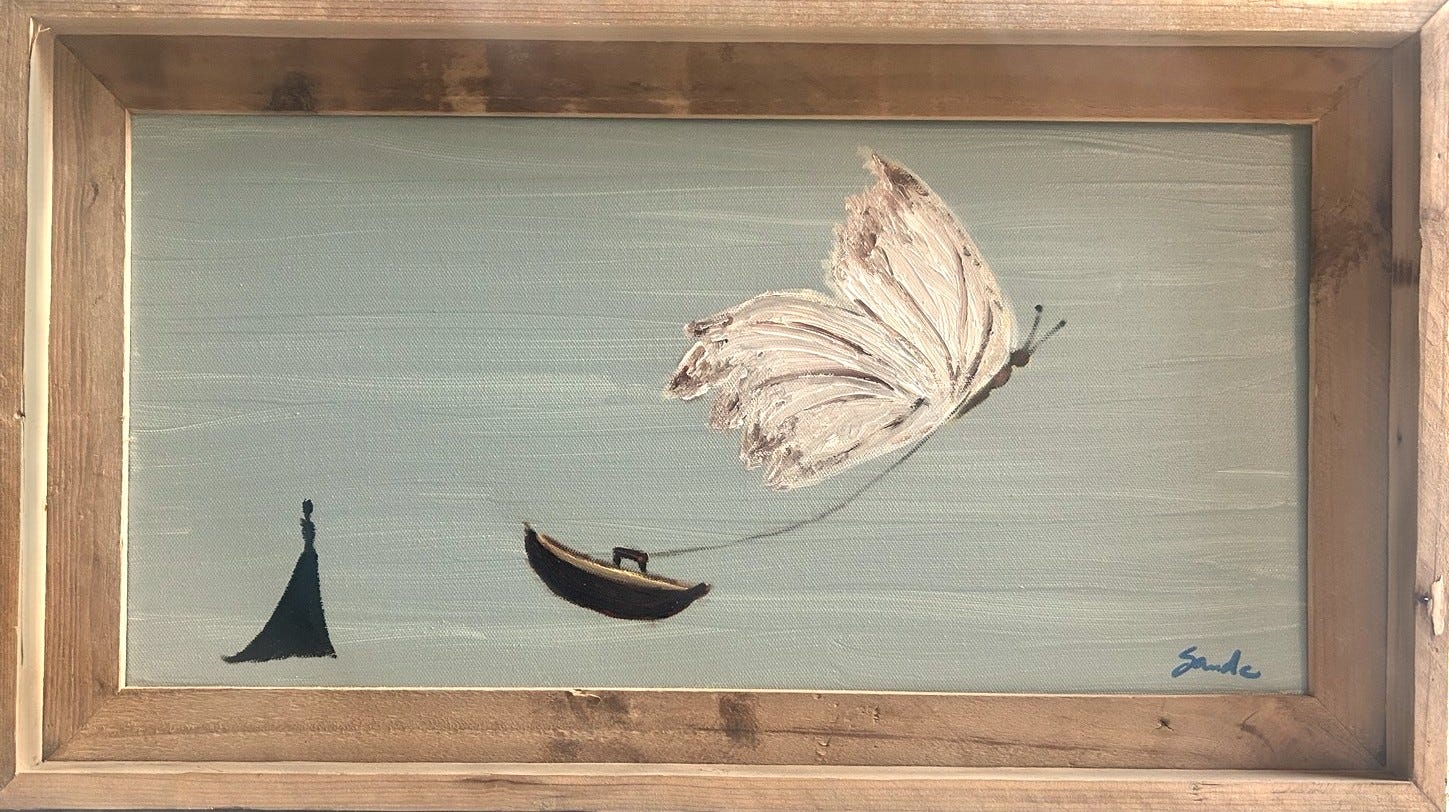
It shows a small boat on a river and a butterfly above it, much too large for the landscape. She still can’t decide whether the butterfly is carrying the boat away or bringing it back. She has been considering the matter for several days, without making much progress.
She picks up a brush and considers painting the butterfly’s wings shades of yellow. Then she looks at the woman standing there in her black dress and the butterfly, which seems content with its present color and puts the brush down.
Perhaps yellow requires a painting of its own.