
Transformations - I
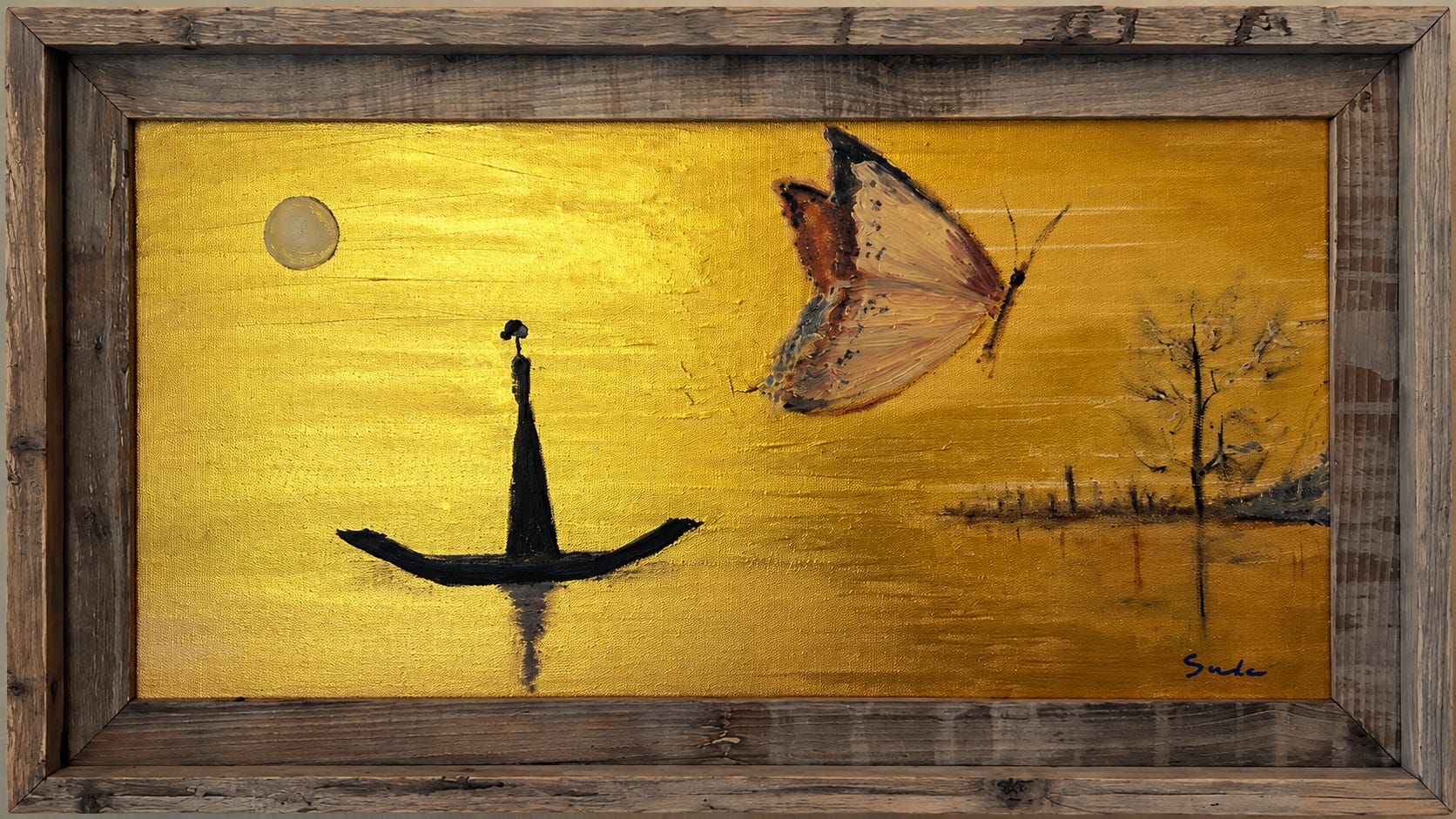
Every morning, before the sun rises and before the village begins the business of being a village, she takes her boat out onto the river.
She has been doing this for many years, and although her husband maintains that it started shortly after the birth of their second child, when she developed the habit of waking before everybody else and had apparently concluded that, having achieved this considerable advantage, she ought to make something of it - she herself remembers no such decision. What she remembers is going down to the river one morning and seeing the boat, which might or might not have been there before. She remembers taking it out and then doing the same the following morning, and the morning after, and that was it.
Calling it a boat is somewhat generous. It is a small, flat wooden structure, more like a raft, with a narrow raised edge that was supposed to offer a certain reassurance against the possibility of sinking. She calls it her boat. Technically it probably belonged to someone else in the village, but since nobody had ever disputed her ownership, she saw no reason to complicate the matter and call it “the boat that was originally someone else’s boat, but now I use it every morning and hence it’s mine”.
The river is not unusually wide where it passes the village, but a little farther downstream it becomes much wider. The inhabitants call that part “the lake”. The geography teacher had repeatedly pointed out that a widening of a river did not qualify as a lake, but the objection did not make much impression on the villagers, who had been calling it “the lake” for several generations.
The geography teacher is, of course, the woman in the boat.
She had eventually abandoned the argument, partly because it was exhausting to contradict an entire village, but mostly because, given its stillness,“lake” seemed a more suitable name for a place where one goes to do absolutely nothing. Which she does.
Every morning she follows the same path, letting the slow current carry her toward the widening of the river, I mean the lake.
For these excursions, she always wears a long black dress. She has several dresses, of course, but this certain one makes her feel rather mysterious, and she thinks it is especially appropriate for the mornings on the lake. She dresses much less interestingly (and much more colorfully) when she goes to school.
The sun rises slowly above the opposite bank, turning the water first gray, then yellow, and finally a rather extravagant gold. She has been watching this transformation every morning and still thinks it is very poetic indeed. She knows perfectly well, of course, that the sun is not actually rising and that those amazing colors are produced by the scattering of light through the atmosphere and that there is nothing “magical” about it, as she had heard some tourists saying the previous summer. Besides, poetic and magical are not the same thing and poetry, as far as she is concerned, has very little to do with magic, and quite a lot to do with noticing things that other people pass by without paying attention. She finds it irritating when people confuse the two, but she nevertheless decided not to correct the tourists.
She likes these mornings on the river especially because they allow her thoughts to wander freely, following one idea after another, sometimes in directions she has never intended to explore. She finds poetry especially useful for this, inspiring her thoughts and carrying them from one thing to something entirely different, often without a very convincing explanation of the route. The whole experience seems creative rather than chaotic, and somehow perfectly in keeping with the poetic gold of the water (a thesis she was prepared to defend at any time, and actually had on several occasions, mostly in discussions with her husband, the ones that started with “Where is the salt?” and ended with a memory from the time they were dating, when he had brought her carnations instead of roses).
On certain mornings she recites in Greek while on others she prefers Latin. Occasionally Persian (her pronunciation is less reliable in Persian, but she strives to improve it). Once, after a difficult night with her youngest child, she recited a passage from Shakespeare with such conviction that a heron abandoned its fishing place and flew to the opposite bank. She saw this as criticism of her performance. Not a remarkably informed one, for that matter.
By the time she returns home, her three children are usually awake, her husband has already made coffee, and somebody has misplaced something essential. She helps locate the missing object (they always demand to know how she knows where it is), drinks her coffee, and then goes to school.
She is the village schoolteacher. She teaches history, geography, grammar, poetry, and literature, as well as chemistry, which had entered her professional responsibilities by a route so complicated that neither the school authorities nor the woman herself could explain it with any confidence.
Her original interest had been English literature, which had gradually expanded to literature in English, which basically meant (she had to explain this in different occasions) that it included works that had not originally been written in English at all.
Somewhere along the way, she had developed a special interest in the classics, that is, the real ones, the Greeks and Romans. She soon discovered that different translators could produce remarkably different versions of the same text, some excessively sophisticated, others painfully unnatural, and occasionally so different that she wondered whether they had been reading the same piece. She began to suspect that some translators had taken too many liberties with the ancient writers, so obviously, she decided to learn Latin.
Latin proved to be quite an exciting journey and much less difficult than she had expected, so in a moment of enthusiasm, she decided to learn Greek as well. Greek turned out to be a very different kind of endeavor, though she still remembers the immense pleasure she felt when she was finally able to read her first sentence.
All this took several years, during which she found confirmation that the translators were indeed taking different kinds of liberties with the texts, but also, to her astonishment, discovered that the ancient authors were less well behaved in their original languages, and this made them much more interesting.
She started reading Herodotus’ Histories for an account of the wars between the Greeks and Persians. After a while she found herself increasingly interested in the Persians. She thought it was rather unfair that we knew so much about them from the Greeks, who had defeated them and then proceeded to write their history. At quite a length, too.
She wanted to know what the Persians had to say about themselves and consequently had to do further reading, which led to Persian poetry, which led to the study of Persian, which she initially intended to pursue only far enough to appreciate a few verses by Omar Khayyam, but which soon expanded into a much larger enterprise involving kings, gardens, astronomers, physicians, mathematicians, and an astonishing number of discussions about wine.
From wine she arrived at fermentation, and from fermentation at the history of alchemy and medicine, where she discovered that Persian and other scholars of the medieval Islamic world had devoted significant attention to the properties of substances that could heal a person in one quantity and kill him in another. That naturally evolved into an interest in poisons.
Her husband was not delighted. He had tolerated Greek, Latin, and Persian without complaint, and had even become accustomed to finding unfamiliar alphabets on the backs of shopping lists, but one evening, when she began explaining, over dinner, the various historical methods by which inconvenient relatives had been removed from royal households, he listened for a while, then put his fork down.
“Do you have to tell me this at dinner?”
“When would you prefer?”
He thought about it.
“I wouldn’t.”
By then she had already begun studying chemistry, which she deemed indispensable to understanding the making of poisons, and chemistry turned out to be an enormous subject, way beyond poisons, covering practically everything in the universe, including the composition of water, the burning of wood, the fermentation of grapes, and the reasons why certain substances could be mixed together with excellent results while others produced explosions. She did not attempt the explosions at home.
When the village school found itself without a chemistry teacher, she volunteered to take the class temporarily and never gave it back. That was eleven years ago.
Her pupils were happy with the arrangement. It seemed that for them, the division of knowledge into separate subjects was a peculiarity of the school timetable, which says that geography ends at ten and literature begins at eleven, while they saw no clear reason why they wouldn’t be reversed. Or collapsed.
On this aspect, she was in agreement with the children, so one Thursday, for example, she began a lesson with a poem attributed to Omar Khayyam, concerning wine, the brevity of life, and the inadvisability of postponing pleasure. She read the poem aloud, first in Persian, which the children listened to politely (of course, without understanding a word) and then in English (it was unclear if the kids understood more in English), and then explained that the poet was advising his beloved to fill his cup today, since tomorrow was an uncertain business and there was little to be gained from worrying about yesterday. The children nodded and asked questions about the wine.
She explained fermentation, during which yeasts convert sugars into alcohol and carbon dioxide, and from there proceeded to the cultivation of grapes, the climate of the Iranian plateau, the history of trade routes, and the mathematical achievements of Khayyam, who had been an accomplished scholar long before his verses became famous in English translation.
By the end of the lesson, the children had learned about poetry, geography, history, mathematics, and the chemical process by which grape juice becomes wine.
One boy wanted to know whether the grapes were pleased with the result.
She said that grapes were not known to possess opinions on fermentation. He believed this to be unfortunate.
The school inspector, who visited the following week, was less enthusiastic about her methods. He had arrived in a reasonably good mood and had even accepted a cup of coffee, which was unusual for him because he regarded accepting refreshments from teachers a potential threat to his impartiality, but he had made an exception for coffee, however, on the grounds that he could hardly be expected to assess the educational standards of an entire village before ten in the morning without any assistance.
The inspector looked through her lesson notes and seemed confused. “Was this a chemistry lesson or a literature lesson?” he asked. “Both,” she answered genuinely, and then wondered if she should have chosen. “I can’t find Omar Khayyam in the curriculum for either subject,” he stated. There was not much she could say to that, so she stayed silent. He looked at her for a while and then wrote something in his notebook.
It was during another lesson, some weeks later, that the question of butterflies arose.
They had been reading Ovid’s Metamorphoses, a work she found suitable for children because it contained gods behaving badly, humans behaving worse, and a great many transformations that were not always improvements on the original arrangements. A woman became a tree to escape an unwanted admirer. A skilled weaver became a spider. A young man became a flower. The gods, who were responsible for most of these changes, appeared to regard transformation as a convenient solution to problems that might otherwise have required patience, apology, or a modest improvement in character.
From Ovid they moved to the natural world, where transformations occurred without divine intervention and were, on the whole, conducted with greater consistency.
She described the metamorphosis of a butterfly.
The children knew the general procedure. A caterpillar ate leaves, grew a lot, formed a chrysalis, and eventually emerged as a butterfly. She explained that the process was more complicated than it appeared, involving the reorganization of tissues and the development of structures that the caterpillar had not previously used.
Then she made the mistake of referring to the butterfly as the more advanced form.
“But is it better?” asked the girl with a red blouse.
“Well, it can fly.”
“So?”
Admittedly, the girl had a point, which made her all the more irritating.
“I suppose it depends on what you want to do.”
“What if it doesn’t want to fly?”
“It’s a butterfly. It doesn’t get to choose.”
She regretted saying that.
The butterfly could fly, certainly, which was an advantage if one wished to travel faster. On the other hand, the caterpillar had never shown any distinct interest in travel, it was well equipped for its own occupations, possessed an admirable appetite, and could spend most of its time eating, an arrangement that many adults would have maintained is enviable.
The butterfly, meanwhile, had acquired wings but also a new set of difficulties. It had to find food, avoid predators, locate a mate, and accomplish the business of reproduction within a very short time.
She thought she had found a satisfactory answer and explained that the two stages served different purposes. The girl with the red blouse didn’t look satisfied with the answer.
Another child raised his hand. He had a novel idea to present: ”My dad says I ought to be better than he is,” the boy said. “So why aren’t the butterfly’s children bigger and stronger butterflies? Why do they have to start all over again as caterpillars?”
While she was trying to find an appropriate answer, the kid had an even better suggestion. “Maybe the butterfly kids ought to be birds?”
This produced a lengthy discussion.
Another boy pointed out that birds were frequently eaten by cats, which could not fly, so flight was evidently not a sufficient measure of superiority and why would the birds be superior to butterflies was a question left completely unsolved.
A boy at the back wanted to know whether the butterfly could become a caterpillar again if it changed its mind. She explained that this was impossible, which he found unreasonable, especially since his older brother had recently decided to become a carpenter after spending three years preparing to be a dentist, and nobody had suggested that this was impossible.
She didn’t have too much choice but to allow the argument to continue until the bell rang.
That evening, while cutting onions for dinner, she thinks again about the children and their questions. The girl in the red blouse has been particularly irritating. She isn’t sure why, most likely because the girl was right.
Her youngest comes into the kitchen.
“What’s for dinner?”
“Soup.”
“Again?”
“Yes.”
She continues cutting the onions. They are already too small.
“There’s bread.”
“Is it fresh?”
“Yesterday’s.”
The child leaves.
She returns to the butterfly and her pupils, who are becoming rather troublesome. She has taught them to question things, of course, but hadn’t anticipated that they would become quite so good at it.
Still, she has to admit, they have some good points. A caterpillar does not become a butterfly because it has grown dissatisfied with crawling and has decided to evolve. It does not spend its early life studying the principles of aerodynamics or observing the superior habits of winged insects. It simply follows the course of its existence, and at a certain point this requires an extensive rearrangement of its body, which results in a butterfly. It occurs to her that she has never questioned whether this constitutes an improvement, but in truth it depends entirely on whom one asks, and nobody ever asks the caterpillar, or the butterfly, for that matter.
She thinks about this for some time, until one of the children comes into the kitchen to ask when dinner will be ready. She looks at the pot and realizes she has forgotten to turn on the stove.
The following morning, she takes her boat out onto the river.
The sun has not yet risen, and a thin mist lies over the water. She pushes away from the bank with her pole and allows the current to carry her toward the widening beyond the village, the one they all call “the lake”.
She thinks about Ovid and then she thinks about the girl with the red blouse, the one who asked whether the butterfly was better.
This naturally leads her into thinking about her own peculiar path, which began with a desire to read literature and has led, by a series of unclear turns, to the teaching of chemistry in a village school. She never intended that. Nor, for that matter, did she intend to become a scholar of Persian poetry, although she now possesses three dictionaries, at least seven books on the subject, and a habit of reciting verses whose pronunciation she continues to improve. She has also become a mother of three somewhere along the way, a kind of crochet expert, and a woman who still becomes irritated when an English translation makes an ancient Greek sentence sound more elegant than it has any right to be.
She is considering how complicated all this seems when a butterfly passes over the boat. It is unusually large, with pale wings edged in dark brown, and it flies low above the water. She watches it approach the opposite bank, hesitate above a patch of reeds, and disappear among the trees.
She thinks again about Ovid.
She has been reading Ovid for more than twenty years, first in English, then in Latin, and has changed her opinion of him several times. She has also changed her opinion of Herodotus, of Khayyam, of chemistry, of teaching, and of a great many other things, including the proper age at which children should be allowed to use sharp knives.
The sun is now above the trees. The mist is lifting, and the water has acquired the bright gold color she likes best. She has never found a satisfactory word for it in any of the languages she knows. Perhaps there is a word in another language, she thinks.
Then she starts to recite Ovid, but halfway through, she stops.
She allows the boat to drift.
By the time she reaches the village, she has decided to begin learning Arabic.