
Grandmother had three drawers.
One for documents.
One for money.
And one for keys to houses that no longer existed.
The houses that no longer existed were very important, even more important than the houses people left behind when they moved somewhere else.
That didn’t happen very often in Ada’s grandparents’ village. It happened mostly in the city, where she lived with her parents.
In the city people moved from house to house, or from one apartment building to another, and they never seemed to care very much about the places they left behind. There was always something better: a larger apartment, an east-facing balcony, closer to downtown, closer to the forest so they could breathe some clean air instead of all the traffic fumes. Countless other reasons.
The important thing was that people moved because they wanted something better.
In Ada’s grandparents’ village it was different.
People didn’t move into other people’s houses just like that, for no particular reason, because a house wasn’t simply a temporary solution to a problem of space, light, or neighbors.
If they needed more space, they built another room. If they had money, they replaced the roof. If they had more money, they built a better cellar, a sturdier attic, or a larger house on their own land, and if things went well enough, they bought another piece of land from the neighbors. But they rarely left.
Leaving was regarded with a certain suspicion, as though you had abandoned a conversation halfway through.
Perhaps that was why Grandmother kept the keys.
Not all of them, of course. The keys to houses where people still lived were kept somewhere else and used every day, which made them rather uninteresting.
The drawer was for the keys left without doors, without locks, without thresholds, and without people coming home in the evening. Keys to houses that had been demolished, collapsed, or forgotten by relatives who had moved to the city and then farther away, to other cities where they probably had nicer balconies and cleaner air.
One had belonged to an aunt who had moved to Canada and sent Christmas cards every year, although after a while nobody was entirely sure whether she still remembered exactly where the house had been.
There was also a large, black, heavy key that Grandmother said had belonged to a house that had ceased to exist before she herself had been born.
“If the house doesn’t exist anymore, what’s the key for?” Ada asked one day.
Grandmother shrugged.
“It isn’t for anything.”
“Then why do you keep it?”
Grandmother didn’t answer. She looked at the key for a few seconds, turning it between her fingers, then put it back in the drawer.
That night Ada was awakened by a sound.
It wasn’t loud, but it had something precise and metallic about it, as though two objects had lightly touched somewhere in the house. She lay perfectly still, her eyes open in the darkness, trying to decide whether she had only dreamed it.
The sound came again.
This time it was quieter, almost hesitant.
Ada sat up a little in bed. She wanted to call out. She wasn’t exactly frightened, but she wasn’t entirely at ease either. She thought about Grandmother’s drawer, about those useless keys that opened nothing.
She stayed like that for a few seconds, holding her breath. Then the silence settled back into place.
Ada lay down again, telling herself that by morning everything would make sense.
The next morning, she found Grandmother in the kitchen. She was already sitting at the table, her hands folded.
Ada stopped in the doorway.
“I heard a noise last night,” she said.
“It happens sometimes,” Grandmother said.
“What happens?”
“The keys.”
She said it simply, without mystery, as though she were explaining why water boils or why rain falls.
“Why?”
Grandmother shrugged.
“I don’t know. Maybe when nobody remembers them anymore.”
Ada didn’t ask any more questions.
A few weeks later, one of the keys disappeared.
It was small and rusty, and Ada thought it was one of the ugliest and most insignificant ones in the drawer.
Grandmother emptied the drawer.
Then she emptied the wardrobe and put everything on the bed. She cleaned the whole room. She carried the rugs outside. She went into the next room. She emptied the wardrobe there too. Then she went into the third room. Finally, she went down to the cellar. There she began wiping every jar. She picked one up. Looked behind it. Put it back. Picked up the next one. Looked behind it. Put it back. Ada counted thirty-seven jars before she grew bored and wandered away.
That evening Grandmother invited two neighbors over. They sat beneath the walnut tree and talked for a long time, in low voices. Ada found something to play with nearby, and they let her stay, although they had sent Grandfather away to “mind his own business” when he came to ask what had happened.
They talked about the house whose key had disappeared during the night. About the blue gate. About the room that faced the sunrise. About the large tiled stove in the guest room, one of those made in Aiud by a famous stove builder. About the well, which had stood a little to the right of the house, some thirty paces away. They talked about the roof, about the tiles. Ada understood very little of what they were saying, but she listened as they rebuilt the house piece by piece, room by room.
“The cellar was very large,” Grandmother said. “Twice the size of ours.”
One of the neighbors was silent for a few seconds.
Then she said,
“It was old Dinu’s house.”
Grandmother nodded, satisfied.
That evening the key was back in the drawer, and nobody seemed surprised.
Years later, Ada was returning by train from her grandparents’ village.
The keys were in a cloth bag, tucked inside her suitcase. She wasn’t entirely sure why she had brought them.
She had inherited the three drawers and had spent almost the entire summer putting papers in order, airing out the rooms, and wiping the dust from things.
She had tried to decide what to do with the house. She told herself she could come at least during the summers, walk through the forest during the day, and write beneath the walnut tree in the evenings.
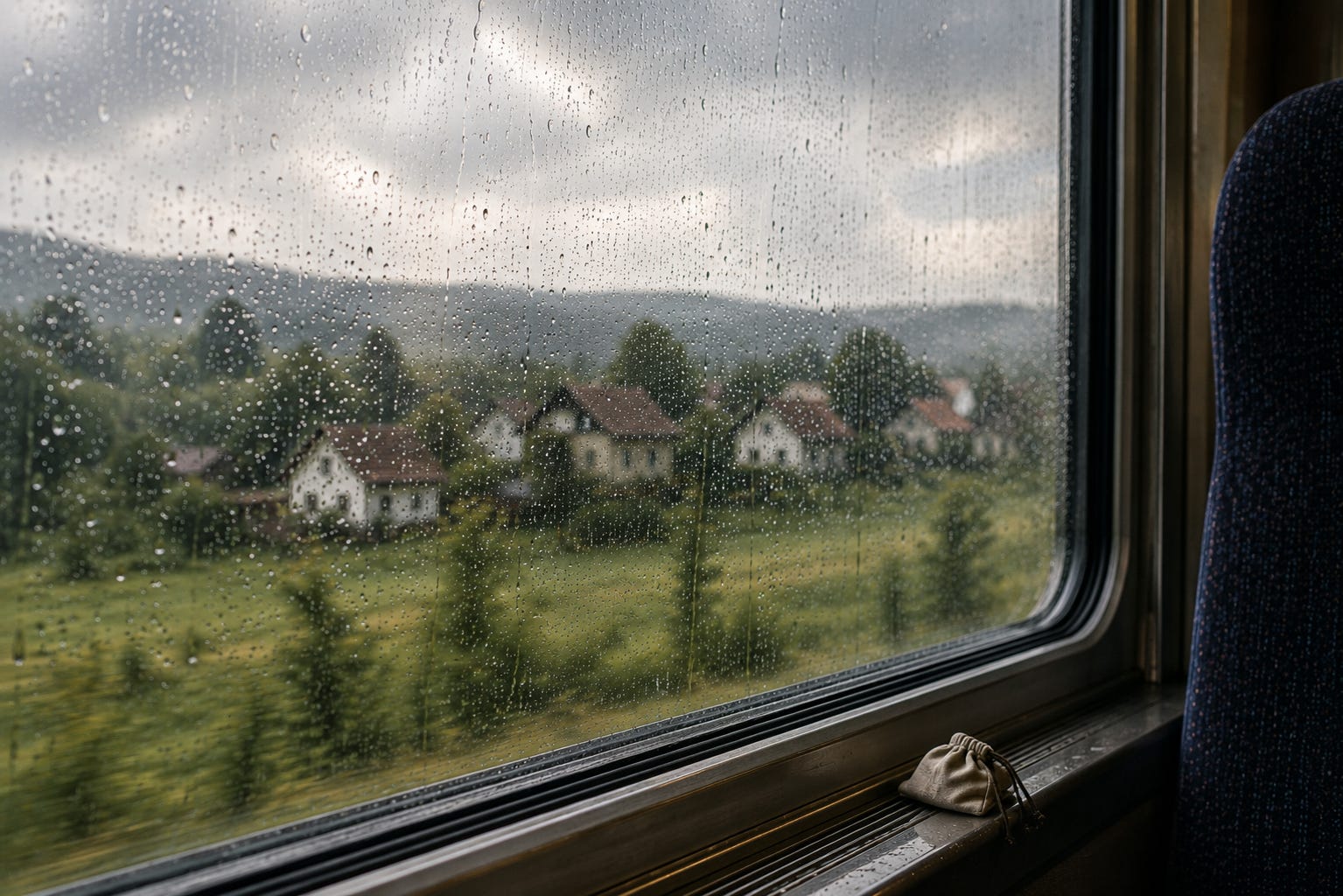
It had rained almost all day, and the carriage was nearly empty. At one of the stations an old man boarded the train and sat down in the seat beside her. They talked for a while. About the rain, about trains, about how much the villages had changed. Then they sat in silence for a while.
When the train reached his stop, the old man stood up, picked up his bag, and held out his hand.
“Dinu,” he said.
Ada watched him step off the train, his figure disappearing into the rain.
She reached for her bag. She could feel the keys inside, cold and heavy. Back in the village, she would have taken them out and counted them. One by one.
She remained like that for a few seconds.
Then she took her hand away from the bag.
She turned back to the window.
The rain was erasing the fields, the houses, the roads.
Field Note
ABSENCES HURT ONLY IF YOU GO LOOKING FOR THEM.
RESULTS VARY DEPENDING ON LOCATION.
This uncanny short short‑story carries a distinctly Poe‑esque tone. The keys—silent witnesses to the lives of houses—seem to possess a will of their own. As long as someone keeps them, there remains a chance to piece together, if not the house itself, then the story of the house.